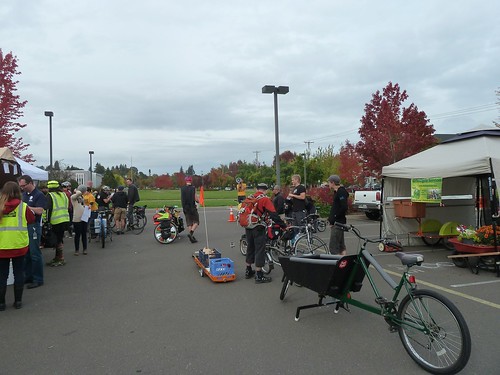
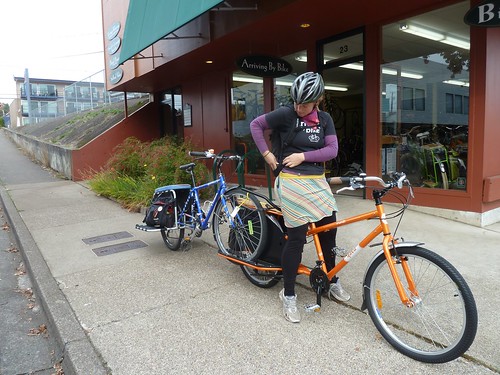
August 15-18 I rode my first 1000km (621 mile) brevet, the
SIR Seattle to Crater Lake 1000K.
I typically learn something from every ride. I particularly learn when things don't go well ... so in that regard I didn't learn as much from this ride as I might have, because the ride went well. But having never ridden more than 600km before, and having never had a multi-day ride that started at night, learning that I can do it is worth quite a bit. My confidence of being able to be ready for Paris-Brest-Paris in 2015 is bolstered.
Cyndi and I drove from Eugene, picked up Asta in Portland a little after 2, and reached Bremerton with time to nap a bit before the start. Not that real sleep was possible, but I think the quiet resting time may have been worth something. The ride started at 10:30pm, with the idea that we would ride through Thursday night and Friday before our first stop Friday evening, 400km (250 miles) down the Washington and Oregon coast to Pacific City. (Some people chose to ride farther, to Lincoln City for the first overnight.)
One of the first decisions one makes on a brevet is how fast to start. Try to ride with a fast group for a while? Go out slower to preserve energy for the long ride ahead? A benefit of staying with the fast kids early was that many of them knew their way out of Bremerton, and I didn't. Moreover, while they were moving at a pace I couldn't maintain forever, it wasn't
that fast; I knew I could keep it for at least an hour or two. Sticking to a fast wheel for a while meant building up a reserve of time that might ultimately be traded for sleep later, so that's what I did. Before long we were a paceline, taking relatively long pulls, and I found I could take my pulls without getting too exhausted, at least for a while.
Fairly early on, maybe an hour in, a car gunned its engine as it passed us, then quickly disappeared around the bend. A moment later we heard the sound of peeling out. But it was probably not peeling out; what we heard was surely skidding breaks, because when we rounded the bend the car (presumably the same one) was off the road on the left, and just beyond it was a pickup, upside down in the left lane. We stopped. I could hear one man asking "is everyone ok", another man cursing at him, and a woman sounding a bit hysterical. Since everyone seemed to have exited their vehicles intact, and since we hadn't actually witnessed the accident, we rode on.
I remember only three stops in the first 200km (125mi). The first was the brief pause at the accident. The second was an "information control"in Matlock, where we were required to find the brand of gas sold as evidence that we had followed the correct route. We probably spent about 20 minutes there, taking time to drink and pee and eat and prepare a little more food to be eaten while riding. I believe some riders who had come off the back of the group rejoined us there, as well. The third stop was at Raymond, 170km (105 miles) in. By that time I had fallen off the back of the group, and found my way to the convenience store alone. I told the clerk that I imagined she had recently initialed brevet cards for the riders who reached there before me, but she said she had not, which was curious. After I refilled my water bottles and prepared a bit more food, just as I was riding back to the main highway I saw another small group of riders go by. I chased them, caught up, and joined that group ... but it was the same group I had ridden with earlier. I learned that they had found a restaurant open and had coffee, which took more time than my convenience store stop, and gave me one last chance to take advantage of their pace. We finished the first 200km in just over 8 hours (means about 6:30am, so about dawn), and I dropped off for good to avoid wearing myself down too far.
Without the group I was much, much slower, but still at an acceptable brevet pace. It was fully light when I reached Astoria and rode, at a slow pace, across that long long bridge. There I turned off course slightly to have breakfast at Pig'n Pancake, where once again I saw the bicycles of the group I had ridden with. They were enjoying breakfast at a table; I sat at the bar on the guess that it was the fastest way to get in and out. The hash browns and eggs tasted great. Then ice cream. And coffee. The worst coffee I have been served in a restaurant, I think. But I got in, ate a bunch, and got out in good time, so overall I consider it a success despite complete failure to caffeinate.
Speaking of caffeine, and of food: While I prefer "real food" when I can get it and eat it, I have increasingly resorted to highly processed "energy" foods on rides. I first tried Hammer Perpetuem (a food drink) on The Big Lebowski last summer, thanks to my riding partners Susan and Lesli, and it worked to fuel me when my stomach was refusing other forms of food. I used Perpetuem again on this ride, particularly at night because it's easier to reach for a bottle than to fumble around for other foods. I also used gels (Gu) and gelatins (Clif Shot Blox). All of these come in caffeine-enhanced forms. I would not have been able to hang with the fast group if I couldn't keep fueling myself in that manner. Shot Blox in particular worked very well for me all three days of this ride, along with the occasional gel.
Near the end of the first day, I felt a second wind and rode several miles at a brisker pace, including a stretch with Theo and James. But here I miscalculated: Less than 20 miles from my overnight in Pacific City, the second wind left me, and I was much slower that I should have been to finish that last little bit. When I finally did reach the hotel, I was too exhausted to eat much, and went to bed without a substantial meal. Fortunately I had enough time in the bank to sleep almost 4 hours, and when I woke I was able to eat the chowder Cyndi had brought for me, and probably something else I don't recall.
I rolled out Saturday morning just after 1 (having heard that others planned to leave around that time). I rode for a time on Slab Creek Road with a group of Bay Area randonneurs, and stopped with them briefly at Lincoln City, but then went on ahead when they chose to have a sit-down meal in the Safeway there. Riding alone now, I rode on to Newport, where I found Newport Cafe open. And inside Newport Cafe, Asta and Kerin! Also excellent hash browns, eggs, and corned beef hash, and palatable coffee. Asta and Kerin finished and left before me, so I left Newport alone again.
I do not recall the next segment of the ride in great detail. It was foggy and misty. At some point I passed the Bay Area randonneurs as they paused at an overlook. It cleared and became warm, and I stopped at Honeyman park to remove a layer and put on sunscreen. Somewhere (around Waldport?) I had a strong spell and rode faster. In other places I rode slower. Eventually I came to Reedsport, where I again met the Bay Area riders and others. I had a tub of potato salad, refilled my water bottles, rested a bit ... and then off toward Roseburg, riding with the Bay Area randonneurs again for a stretch.
The Bay Area randonneurs organized a very disciplined paceline: The leader was to maintain a steady 16mph and pull off at the next milepost. In most pacelines I have ridden, pulls are much shorter than a mile, but I think I understand the rationale for these long pulls. First, the milepost is a definite marker, much easier to track than a shorter distance or time. Second, while shorter pulls are probably less taxing physically, a constantly rotating paceline is more mental burden, and on a long ride our brains are at least as worn as our legs. Even so I found the paceline mentally demanding, and did not intend to join it again after our stop in Elkton. As it was, we did not leave Elkton as a group, and the paceline never re-formed as far as I know. I briefly rode again with a couple of them as we neared Roseburg, but not for long ... I fell behind and rode the last few miles pretty slowly.
Our second overnight was in Roseburg, and just across from Dennys. Dennys was slow, but I managed to have another form of fried potatoes and a milkshake. I was overfull, but could digest while I slept. Two and a half hours? Three? Something like that ... not too bad compared to the amount of sleep I have had on 600s. Asta, Kerin and I rode out a few minutes after 2am. 50 miles in, at Dry Creek Store I took some extra time in the restroom and Asta took a nap on a picnic bench; Kerin rode out ahead and I didn't see her again (though I think Asta did). A little further Asta stopped for a ditch nap and I continued. And a little further yet, a refreshed Asta caught me and went on ahead, skipping Diamond Lake where I stopped for food and rest.
The next segment, from Diamond Lake to Crater Lake, was my weakest. Perhaps I over-ate. Perhaps it was the heat. Whatever it was, I was riding very slowly, and not feeling great. I have ridden that segment before and know it is not nearly as hard as it was this time. Tired and uncomfortable as I was, by this point I was never in any doubt of finishing. It was simply "relentless forward motion" time. I stopped for a while at the rim to chat with other riders, and then longer at the lodge where I bought ibuprofen, drank a lot of water, filled water bottles, and used the restroom. And then down, steeply down ... the decent should have been fun but I wasn't having fun, I was in some physical pain and tired, but it was nice to be making good time again.
Descents end, and one pushes on. In Fort Klamath once again I met the Bay Area riders, along with the ride organizer, stopping for a beer. I stopped for soda (I am quite certain beer would have been a phenomenally bad idea for me), then rolled out just a little before the rest ... and promptly flatted. Changed the tube, checked the tire for sharps and didn't find one, so I put the same tire back on. Whether there was a sharp in there that I didn't find, or whether I under-inflated too far and caused a pinch-flat, I don't know, but by the time I reached the intersection with the main highway into Klamath Falls, my front tire was soft again. I pumped it a little and rode on to a better spot, a closed real estate office with a big porch to work on, where I changed the tube and tire. (I carry three spare tubes and one spare tire.) Clearly I was going to be later than I hoped, but I still felt like I was in no danger of missing the final time cut.
From that point I had a brisk tail wind and was able to ride pretty fast along the side of Highway 97. Fast enough to not see something ... bang ... ran over it with my rear tire. Listening for a hiss ... no hiss. Maybe it's ok. But a few miles later, the back tire is definitely getting soft. So one more time, pull over, dig through my bag for my last spare tube, pull the wheel and remove the tube. I inflated the flat tube just to be sure it really was a pinch flat, indicated by a "snake bite" pair of holes. It is ... whew, that's good, because it means I can put the same tire back on and not worry about sharps. Check it for sharps anyway. I'm tired, I'm being very careful, and I'm really really slow doing this.
Just as I'm getting the back wheel into those awful horizontal dropouts, Roger rides up. Do I need any help? Well, if you happen to have more than one spare tube, could I borrow one? Roger reaches for his tubes, then has another suggestion: Shall we ride in together? Yes yes yes please let's do that but I'll be slow yes please. Roger is a very strong rider. There's no way he should have been behind me, but he suffers from
Shermer's neck. He's had to stop several times to rest until his neck muscles will work again. He thinks he can get in to Klamath Falls without stopping again. I notice that he is sitting as upright as he can, sometimes using just one hand on the bar to be more vertical and reduce stress on his neck. Even so, with the tail wind we make good time. And then we make very slow time trying to navigate the small streets through Klamath Falls, as the bugs come out to celebrate evening.
And, eventually, as it is getting dark, we see the hotel ... with Cyndi and Asta standing on the corner to cheer us in, a nice touch. Pizza, beer, a little time to chat with other riders, and off to sleep.
So what did I learn on this ride? Although I had rough patches, I learned mostly from some things that went right. Riding with the fast group was fine for a while, although I probably should have dropped off a little faster. Eating what I can is better than forcing myself to eat more; even going to bed Friday night without a substantial meal wasn't a catastrophe, while I might have done better to eat a little less at Diamond Lake. Processed energy foods, and Shot Blox in particular, do work for me, although it's still better to eat more "real food" when I can. Keeping a level head and not getting too frustrated was helpful when I experienced a series of flats, and earlier when I wasn't feeling good between Diamond Lake and Crater Lake. Making time when I felt strong, and keeping going when I felt weak, balanced out pretty well. I did lose too much time at a couple controls: Cannon Beach was a mess, and I should have just gotten my control card signed and moved on as quickly as possible. If I had eaten less at Diamond Lake, I might also have left earlier. But mostly things went well. I feel good about it, very good about having made another step in my development as a randonneur, and confident that I am on my way to riding a full grand randonnee of 1200km in the next year or two.
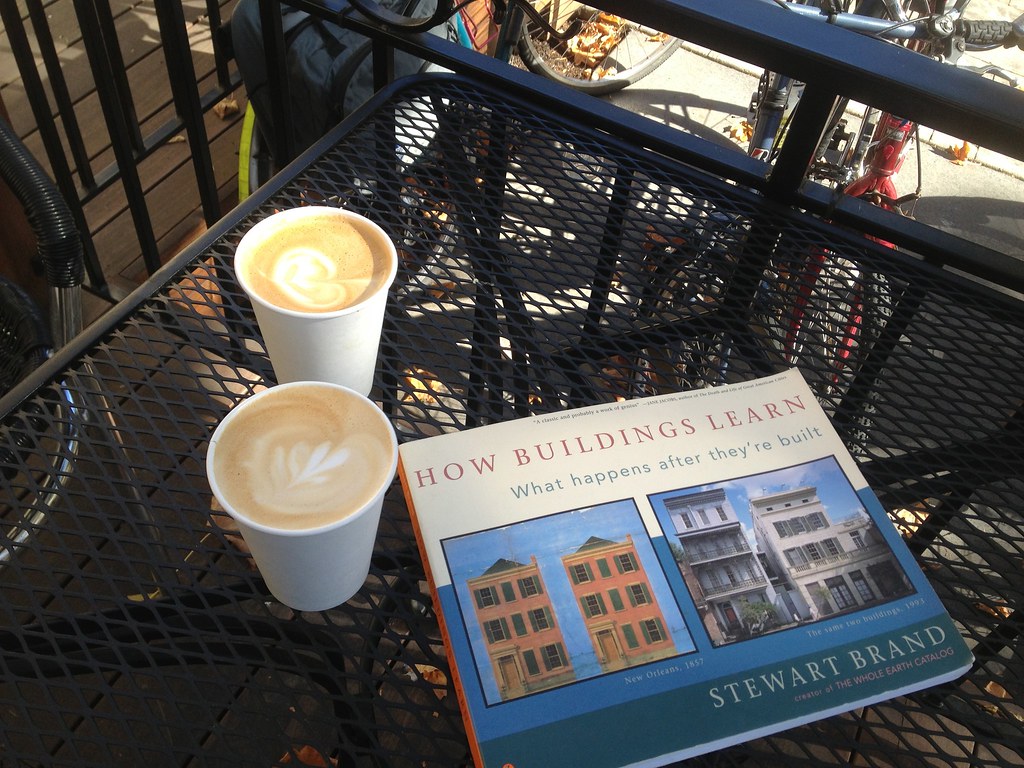
 My original plan was to stop at Eugene Public Library (which has a coffee shop) to pick up one of their two copies of How Buildings Learn, by Stewart Brand (better known to me as the editor of the Whole Earth Catalog). On my way, though, I decided that I should check for a used copy at Smith Family Bookstore first. Software engineers are fond of (building) architecture as an analogy to software architecture, and How Buildings Learn was recommended by a colleague because of the relation between (mostly unplanned) evolution of buildings and (planned or unplanned) evolution of software systems. I thought it would be handy to have a copy of my own to peruse without a deadline, and to draw from for my spring class in globally distributed software development.
 Cyndi called and suggested meeting at Vero Espresso, a few blocks away and not far from where she was shopping. OK then.